



Helicobacter pylori stool antigen testing is an established non-invasive approach for detecting active H. pylori infection. Validated monoclonal stool antigen tests can be used both before and after treatment, while current clinical guidance also recognises faecal antigen testing as an option for confirming eradication.
But once a diagnostic test becomes part of routine laboratory practice, diagnostic performance is only one part of the equation.
The way samples are prepared, organised, processed, traced and reported can have an equally important impact on daily laboratory operations.
This raises a practical question for laboratories performing H. pylori stool antigen testing:
What happens when the test still works, but the workflow around it no longer fits the laboratory?
Diagnostic performance is only part of an H. pylori testing workflow
A diagnostic method can perform reliably for years while the environment around it changes.
Sample volumes increase or become less predictable. Staffing changes. Turnaround expectations become tighter. Laboratories introduce new assays, while urgent requests continue to arrive alongside routine work.
These changes do not necessarily create a problem with the test itself.
They can, however, expose limitations in the laboratory workflow used to perform it.
For H. pylori stool antigen testing, this is particularly relevant because sample preparation, manual handling, batch organisation and result interpretation can all add steps before a final result is available.
A workflow that is manageable at one level of demand may become less efficient when testing patterns change.
Where rapid tests and ELISA can create workflow friction
Rapid tests and ELISA-based methods remain established approaches in infectious disease diagnostics. Their suitability depends on the laboratory, the assay and the testing demand.
However, some rapid test workflows rely on manual processing and visual interpretation, while ELISA commonly involves several manual steps and batch-based processing.
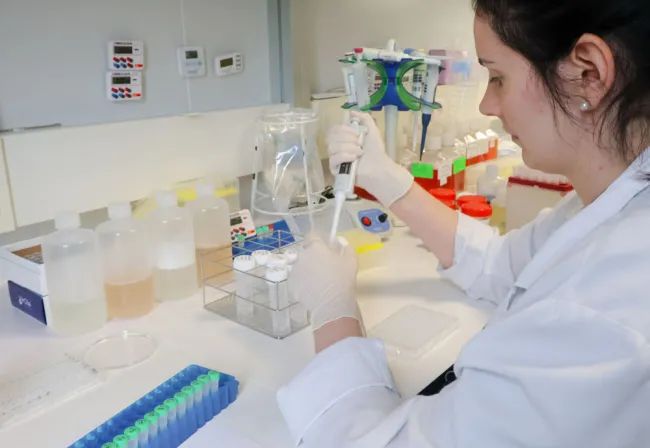
In stool antigen testing, pre-analytical preparation can add another layer of work. Depending on the assay, this may include sample dilution, homogenisation, filtration or centrifugation before analysis.
None of these steps necessarily represents a problem in isolation.
The challenge appears when they begin to create more hands-on time, waiting periods or additional coordination as testing activity grows.
In other words, the diagnostic method may remain appropriate while the workflow becomes increasingly difficult to manage.
Waiting time is part of the real turnaround time
Turnaround time is often described as the time required to perform the analytical assay.
But the analytical run is only one part of the process.
If a sample arrives in the laboratory and has to wait until enough additional samples are available to create an efficient batch, that waiting period also contributes to the real turnaround time.
Batch processing can be highly efficient when sample volumes are large, stable and predictable.
The situation is different when requests arrive individually or fluctuate from day to day.
For variable-volume H. pylori testing, the ability to process a sample when it is required can be as relevant as the analytical speed of the assay itself.
This is one of the main differences between batch-oriented testing and an on-demand workflow.
Pre-analytical handling matters in H. pylori stool antigen testing
Pre-analytics can represent a significant part of the workflow in stool antigen testing because faecal samples require preparation before they reach the analyser.
Reducing these steps can therefore improve laboratory efficiency before automation even begins.
For HELICOBACTER PYLORI Ag VIRCLIA® MONOTEST, Vircell developed the VIRCLIA® EXTRACTION TUBE, which incorporates pre-dispensed extraction solution and a filtration system for stool sample preparation.
This workflow eliminates the need for routine centrifugation before analysis, reducing hands-on work and removing an additional reason to organise samples around a centrifugation step.
This is an important distinction.
Automation should not start only once a prepared sample reaches the analyser. An efficient automated workflow should also simplify the steps required to get the sample there.
From batch processing to on-demand H. pylori testing
On-demand testing allows laboratories to process an individual test according to actual demand instead of waiting to complete a predefined batch.
This does not mean that batch processing is inherently inefficient. For predictable, high-volume workloads, batching can remain an effective model.
The advantage of on-demand testing becomes clearer when volumes fluctuate, samples arrive at different times or laboratories want greater control over when individual tests are processed.
The VirClia® monotest format follows a simple principle: one test, one reportable result.
Each monotest contains the reagents and controls required for the determination, enabling individual tests to enter the workflow without waiting for a complete batch.
For H. pylori stool antigen detection, this means the laboratory can move from sample preparation to automated analysis according to its actual daily workload rather than according to a fixed batch schedule.
Flexible automation with VirClia® Lotus
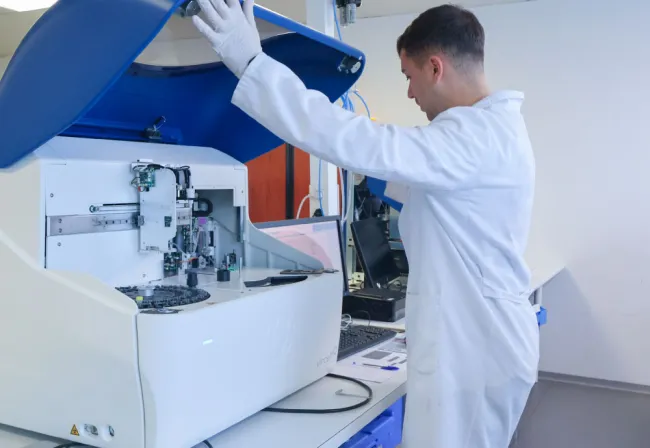
VirClia® Lotus is Vircell's fully automated random-access and continuous-loading CLIA analyser for infectious disease testing.
The system is designed to manage variable testing demand using the VirClia® monotest format. New samples and tests can enter the workflow without waiting for a predefined batch to finish, while STAT functionality allows urgent samples to be prioritised.
VirClia® Lotus supports more than 90 infectious disease markers, allowing routine and specialised parameters to be managed on the same automated platform.
For laboratories dealing with changing volumes, this model provides greater control over what is processed, when it is processed and how priorities are managed.
That flexibility is particularly useful when medium- or lower-volume assays have to coexist with routine testing.
Bringing H. pylori antigen detection into the automated workflow
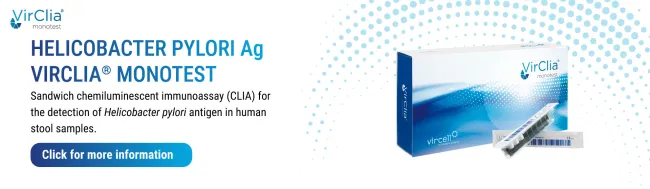
HELICOBACTER PYLORI Ag VIRCLIA® MONOTEST is a sandwich CLIA assay for automated detection of H. pylori antigen in human stool samples.
The assay uses monoclonal antibodies for antigen capture and provides individual quality control for each monotest, without the need for additional controls or calibrations. Results are available in approximately one hour.
Combined with the centrifugation-free pre-analytical workflow, the objective is not simply to automate the analytical reading.
It is to simplify the pathway from stool sample preparation to reportable result.
This is particularly relevant when laboratories want to reduce dependence on manual processes while retaining flexibility for variable testing volumes.
Automation should reduce complexity, not create more of it
The value of laboratory automation is not defined only by the number of steps an analyser performs automatically.
Automation delivers greater operational value when it also supports identification, traceability, prioritisation and result management.
VirClia® Lotus incorporates barcode identification of samples and monotest strips, helping maintain traceability throughout the automated process.
The VirClia® workflow can also connect with laboratory information systems through VirCom® middleware, supporting the transfer and management of results.
The goal is a more standardised, connected and traceable laboratory workflow, rather than simply replacing one manual analytical step with an instrument.
When does workflow flexibility become valuable?
There is no universal sample volume at which a manual or batch-based workflow suddenly becomes inefficient.
The indicators are usually operational.
Samples may spend increasing time waiting before analysis. Technicians may dedicate more time to organising runs. Urgent samples may interfere with routine batches, or different diagnostic methods may require separate processes that become harder to coordinate.
In these situations, laboratories need to assess more than diagnostic performance.
They also need to consider hands-on time, pre-analytical requirements, turnaround time, traceability, staffing and daily testing patterns.
For predictable, high-volume workloads, batch processing may continue to be the appropriate solution.
When demand is more variable, flexible automation can provide a different way of organising testing around the needs of the laboratory.
From a working test to a workflow that keeps working
The evolution of H. pylori diagnosis is not only about introducing new diagnostic methods.
It is also about improving how established methods fit into modern laboratory routines.
For stool antigen testing, that includes looking carefully at the pre-analytical phase, reducing unnecessary manual steps, avoiding waiting periods where possible and ensuring that automation supports rather than constrains daily work.
Vircell has more than 30 years of experience specialising in infectious disease diagnostics, and this focus has shaped the VirClia® approach: automated CLIA testing, a broad infectious disease menu and a monotest format designed around variable laboratory demand.
Volumes change. Samples do not always arrive in perfect batches. Urgent requests appear.
The workflow needs to be able to respond.
A flexible approach to automated H. pylori stool antigen testing
HELICOBACTER PYLORI Ag VIRCLIA® MONOTEST, together with VIRCLIA® EXTRACTION TUBE and VirClia® Lotus, combines simplified stool sample preparation with automated, on-demand H. pylori antigen detection.
The result is an approach designed not only around the performance of the test, but also around the way laboratories actually work.
One workflow. Variable demand. Greater control.


MORE PUBLICATIONS




DO YOU HAVE ANY QUESTIONS?
Contact us