
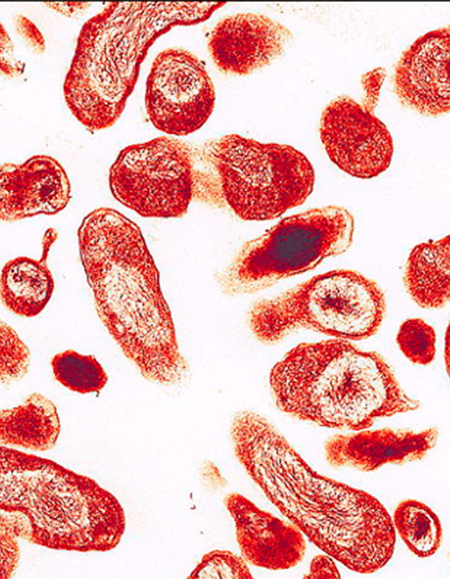
What is Q fever?
Q fever is a zoonotic disease caused by Coxiella burnetii, an intracellular bacterium with worldwide distribution. The bacterium can infect a wide range of animals, with domestic ruminants such as cattle, sheep and goats representing important reservoirs for human infection.
Human infection with Coxiella burnetii occurs mainly through inhalation of contaminated aerosols or dust from infected animals, particularly materials associated with animal birth. The bacterium may also be present in other animal secretions and excretions.
Coxiella burnetii infection may be asymptomatic or cause acute Q fever, which can present with fever, atypical pneumonia or hepatitis. In some patients, infection may later develop into a persistent or focalized form, including endocarditis or vascular infection.
Phase I and phase II of Coxiella burnetii: why do they matter?
Coxiella burnetii has two antigenic variants, known as phase I and phase II, which differ mainly in the structure of their lipopolysaccharide (LPS). Phase I is the natural, virulent form and has a complete LPS, whereas phase II has a truncated LPS and is less virulent. Phase I and phase II are antigenic variants of the bacterium, not consecutive stages of Q fever.
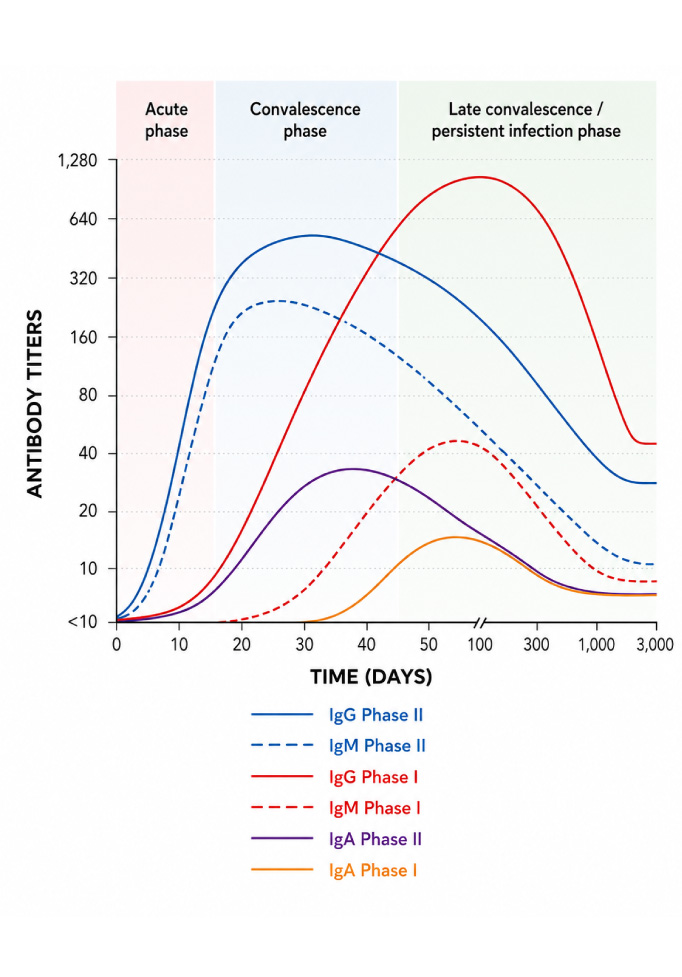
Natural infection occurs with phase I Coxiella burnetii, but acute infection generates a strong antibody response against phase II antigen. The complete LPS of phase I partially masks other bacterial antigens. As the bacteria are processed by host cells, these antigens become exposed to the immune system. The same antigens are more accessible in phase II bacteria because their LPS is truncated, explaining the strong serological reactivity against phase II.
Antibodies against phase II generally predominate during acute Q fever. Phase II IgM and IgG appear during the first weeks of infection, with IgG increasing during convalescence and initially reaching higher titres than those observed against phase I.
Phase I IgG becomes particularly relevant when persistent or focalized Coxiella burnetii infection is suspected. High and persistent phase I IgG titres may be observed in clinical settings such as endocarditis or vascular infection, although serological findings should always be interpreted together with the clinical picture and changes in antibody titres over time.
Assessing antibody responses against both phase I and phase II provides a more complete serological picture of Coxiella burnetii infection.

Challenges in Q fever diagnosis
The diagnosis of Q fever depends on the stage of infection and may involve both molecular and serological methods. Molecular detection of Coxiella burnetii DNA can be particularly useful early in infection, before a detectable antibody response has fully developed.
- Serological tests may be negative during the early stages of acute Q fever. A negative result obtained shortly after symptom onset does not necessarily exclude infection, and testing of a second serum sample during convalescence may therefore be required.
- Indirect immunofluorescence assay (IFA) is the reference method for the serological diagnosis of Q fever. Evaluating antibody responses against phase I and phase II antigens, together with changes in antibody titres over time, provides valuable information for the interpretation of Coxiella burnetii infection.
- A single positive serological result does not necessarily indicate active Q fever. Antibodies against Coxiella burnetii can remain detectable after infection, making clinical context, epidemiological information and the evolution of antibody titres important for correct interpretation.
Cultivation of Coxiella burnetii is not routinely used for clinical diagnosis because the bacterium is highly infectious and requires specialized laboratory facilities.
Vircell’s Solutions for Coxiella burnetii
IFA – Gold Standard for Comprehensive Diagnosis
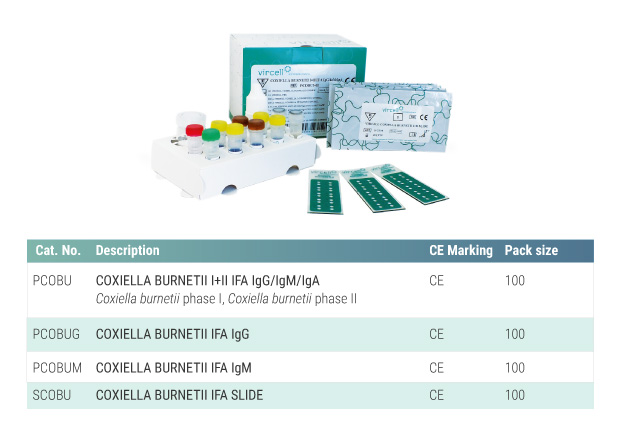
Vircell COXIELLA BURNETII IFA assays enable the serological detection of antibodies against Coxiella burnetii using indirect immunofluorescence.
The Vircell IFA range includes IgG and IgM assays, as well as COXIELLA BURNETII I+II IFA IgG/IgM/IgA (PCOBU I+II), which presents phase I and phase II antigens in separate wells.
Separate phase I and phase II antigens allow the antibody response against each antigenic variant to be evaluated individually, supporting a more complete assessment of the different serological patterns associated with Coxiella burnetii infection.
Vircell complete IFA kits include the reagents required to perform the assay and allow antibody titration, which is particularly useful when monitoring changes in the serological response over time.
ELISA – Phase II serology for higher-throughput testing
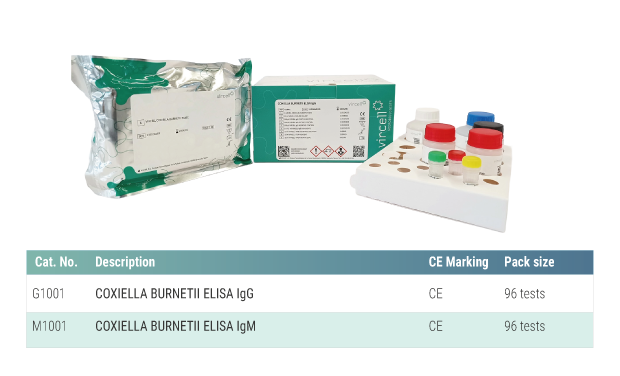
Vircell COXIELLA BURNETII ELISA IgG and IgM assays detect antibodies against phase II Coxiella burnetii antigen in human serum or plasma.
The ELISA format provides an efficient option for laboratories processing larger sample series. When differentiated assessment of phase I and phase II antibody responses is required, IFA provides additional serological information.
Vircell ELISA kits are designed for an efficient laboratory workflow, with ready-to-use reagents, individual break-apart wells and compatibility with automated ELISA systems.
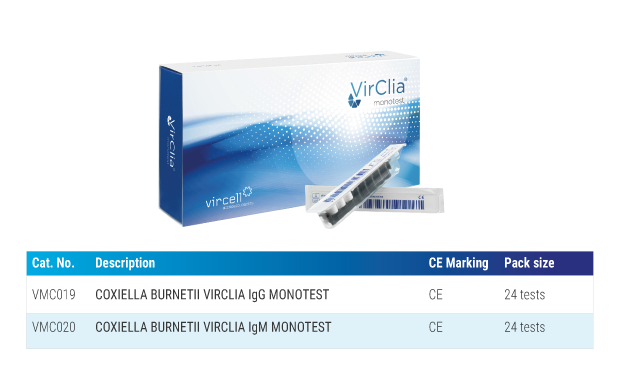
VirClia® – The Only CLIA Monotest for C. burnetii
COXIELLA BURNETII VIRCLIA® IgG and IgM are CLIA Monotest assays for the detection of antibodies against phase II Coxiella burnetii antigen.
The VirClia® Monotest format allows laboratories to process individual determinations without waiting to accumulate samples for a batch. Each strip includes the assay-specific reagents together with a calibrator and negative control.
VirClia® assays are currently processed on VirClia® Lotus, an automated random-access, continuous-loading platform designed for flexible infectious disease testing. Primary sample tubes can be loaded directly onto the instrument, helping reduce manual sample handling.
VirClia® is particularly suited to laboratories that need to run infectious serology on demand, including low- and medium-volume parameters alongside the daily routine.
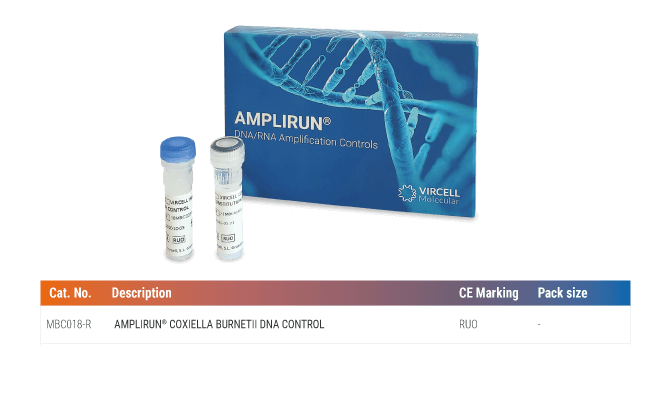
Amplirun® – Complete DNA control for Coxiella burnetii detection
Purified DNA of Coxiella burnetii designed to support molecular workflows and validate nucleic acid amplification techniques (NAATs).
Contains purified, complete microbial genome – any sequence can be amplified
Ideal for assay development, validation, and quality control
Compatible with any molecular testing platform
Non-infectious and safe to handle
Lyophilized format for extended shelf life and easy transport
Technical Comparison Between IFA and VirClia®
IFA (Immunofluorescence)
Multi-well slide
Manual technique requiring multiple incubation and washing steps.
Phase I and II
Subjective reading under a fluorescence microscope, requiring experienced personnel.
Gold standard but dependent on technician expertise.
VirClia® (CLIA Monotest)
Multi-Single-dose automated testplate
Fully automated with a simple, standardized protocol.
Phase II
Automated and objetive, reducing operator variability
High sensitivity with automated and reproducible results.

Bibliography

VirClia® chemiluminescent assays as a tool for detecting Bartonella Henselae and Coxiella burnetii infections
Ir a enlace