
UK meningitis outbreak: from the Kent cluster to molecular quality control in the lab
The meningococcal disease outbreak under investigation in Kent, UK, has brought meningitis back into the public health spotlight.
According to the latest UKHSA update from 19 March, there were 15 laboratory-confirmed cases and 12 further notifications under investigation, bringing the total to 27 cases under investigation, including two deaths. Even so, health authorities say the risk to the wider population remains low.
Kent meningitis outbreak: preventive antibiotics and MenB vaccination
The public health response has focused on people with the highest likelihood of exposure.
Preventive antibiotics have been offered to students at the University of Kent, to close contacts of confirmed or suspected cases, and to people who visited Club Chemistry in Canterbury between 5 and 7 March. A targeted MenB vaccination programme has also been introduced for around 5,000 students and staff linked to halls of residence on the Canterbury campus.
Although this is a local outbreak, the wider message is important. ECDC considers the risk to the general population in the EU/EEA to be very low, but also notes that if a linked case is detected elsewhere in Europe, control measures should be implemented quickly. These include contact tracing, antibiotic prophylaxis, and MenB vaccination where appropriate.
ECDC also reminds clinicians that the incubation period is up to 10 days, so the risk falls significantly after that point, and that recent travel history should be considered when assessing suspected cases.
Invasive meningococcal disease in Europe: why it still matters
Invasive meningococcal disease is uncommon, but it can become severe very quickly. It is caused by Neisseria meningitidis and may lead to meningitis and septicaemia.
In 2023, EU/EEA countries reported 1,895 confirmed cases and 200 deaths. ECDC also reports that serogroup B remains the leading cause of invasive meningococcal disease in Europe.
Meningitis symptoms: key warning signs to recognise early
Health authorities continue to stress the importance of recognising meningitis symptoms early.
Warning signs include:
- fever
- headache
- vomiting
- drowsiness
- rapid breathing
- cold hands and feet
- a rash that does not fade when pressed
Vaccination is an important part of the response, but it is not the whole solution. UKHSA has made it clear that the MenB vaccine helps protect against meningococcal B disease, but it does not cover all strains and does not prevent carriage and spread in the community.
That is why rapid recognition, public health measures, and reliable diagnostics remain essential.
Meningitis diagnosis: PCR, CSF samples and differential testing
When meningitis makes the news, meningococcus usually gets most of the attention. But in real clinical practice, the picture is broader. Meningitis can result from bacteria, viruses, fungi, or parasites, which makes differential diagnosis especially important in urgent settings.
WHO highlights the role of laboratories in testing CSF and blood samples to identify the pathogen involved and guide both treatment and public health action. Current guidance recommends PCR-based molecular testing on CSF samples in suspected acute meningitis cases.
At the same time, culture and antimicrobial susceptibility testing remain essential for bacterial identification and resistance profiling. In other words, molecular testing is key, but it works best as part of a complete and well-controlled diagnostic strategy.
Quality control in molecular meningitis testing
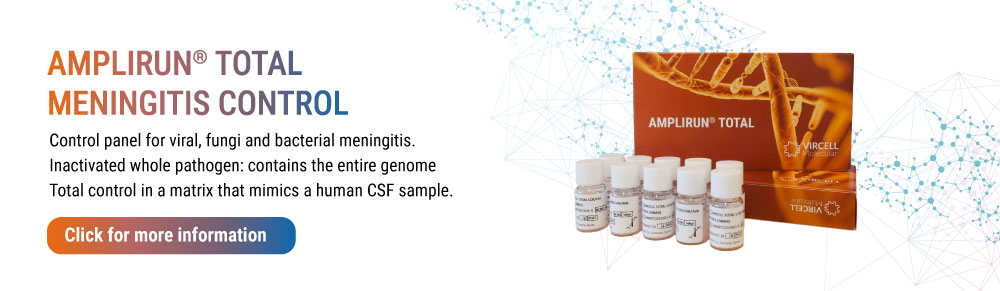
In this context, quality control becomes just as important as speed. AMPLIRUN® TOTAL Meningitis Control is a control panel for bacterial, viral, and fungal meningitis, designed to monitor the whole molecular workflow in a matrix that mimics a human CSF sample.
It includes clinically relevant targets such as: Cytomegalovirus (CMV, Cryptococcus neoformans, Escherichia coli K1, Enterovirus, Haemophilus influenzae, Listeria monocytogenes, Neisseria meningitidis, Human parechovirus, Streptococcus agalactiae, Streptococcus pneumoniae and Varicella-zoster virus.
Key features include:
- inactivated whole pathogen, compatible with different analytical approaches
- total process control in a matrix mimicking human CSF
- low-positive concentration designed to provide clinically meaningful results
- single-use lyophilised format for stability and easy handling
- non-infectious material with an inactivation certificate
- multiple platform compatibility
At a time when the UK meningitis outbreak is drawing attention to symptoms, prevention, and MenB vaccination, laboratories also need tools that support confidence in molecular testing.
If you would like to explore how AMPLIRUN® TOTAL Meningitis Control could support your meningitis molecular quality control strategy, we would be happy to help.